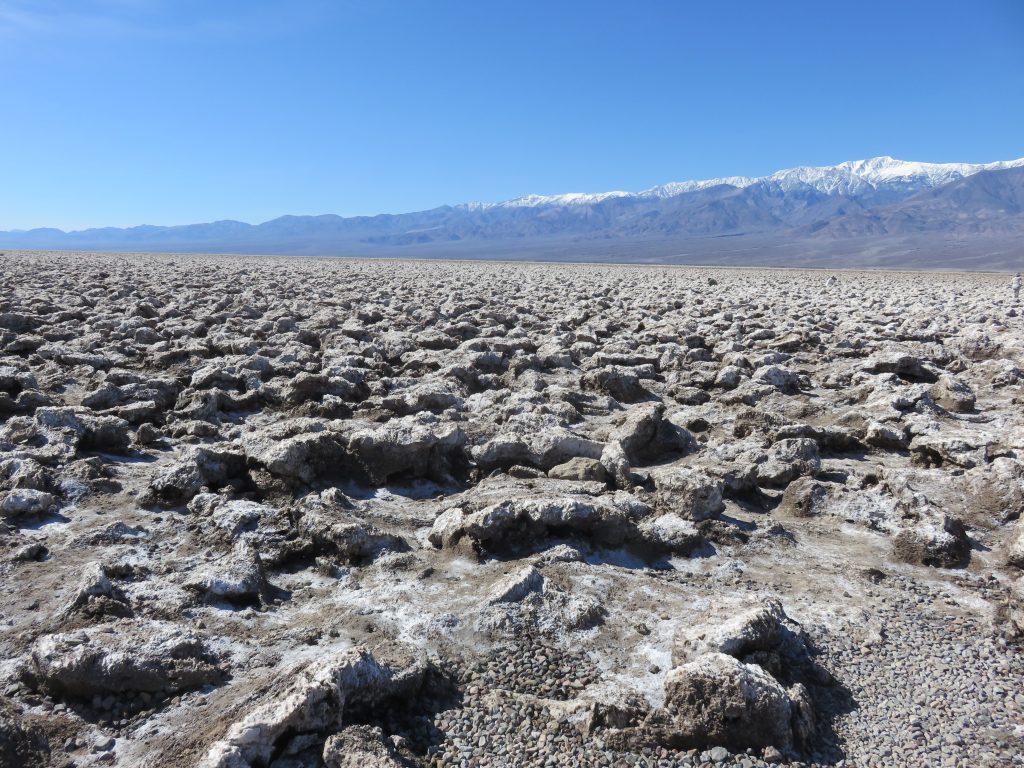
Jagged salt crystals at “Devil’s Golf Course,” Death Valley
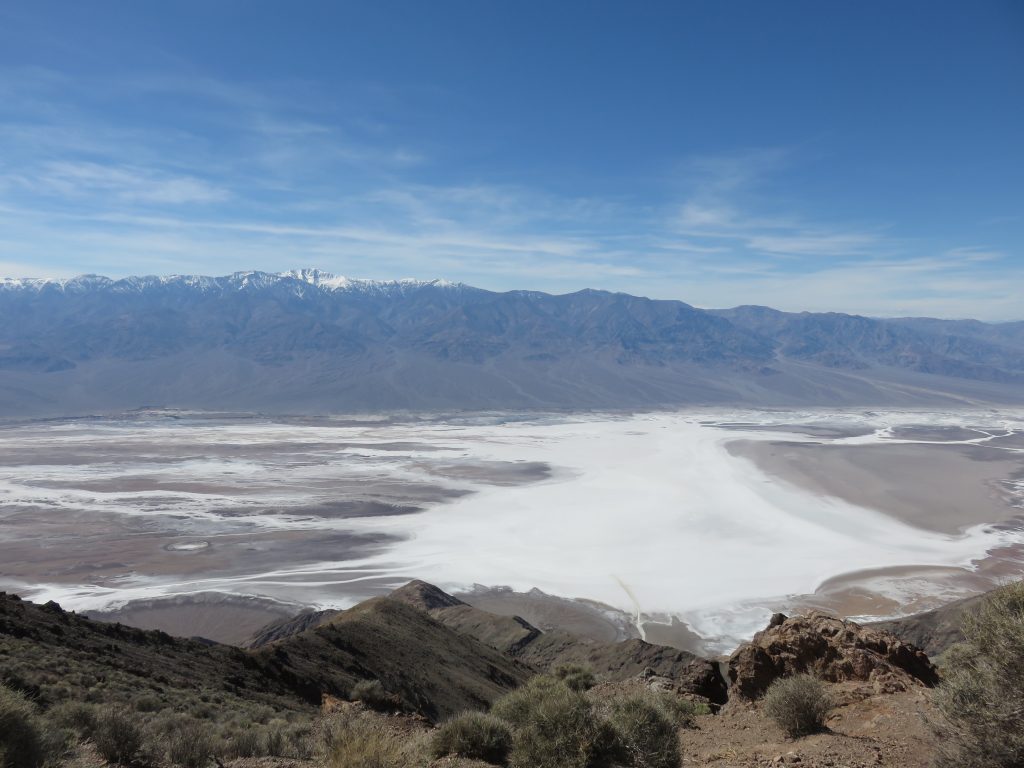
The sign warns that walking on the Devil’s Golf Course can result in falls, cuts and even broken bones! The picture from one mile up at Dante’s View, appears to show a beautiful white salt-encrusted valley floor. The closer picture reveals a more harsh environment of jagged salt crystals, one to three feet tall.
Salt Flats of Death Valley as seen from Dante’s View, one mile above the valley floor.
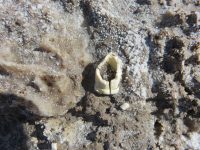
Water evaporating from the lake bed leave behind these large salt crystals that trap soil, rocks, and even old animal bones. Here these massive salt flats are preserved, while in other parts of the Mojave Desert, this type of salt deposit is harvested or mined.
Animal bone trapped in salt crystal, Death Valley
We pass one such salt surface mining operation in the Mojave Desert near the town of Amboy, California, an almost 200 mile drive south of Death Valley. Another place to visit the remains of a lake salt mining operation is Zzyzx in the Mojave National Preserve.
Today begins the annual art show here at the Furnace Creek Resort within Death Valley National Park. The weather forecast this weekend is sunny and warm with a guaranteed chance to see beautiful arts and crafts.
The last 1/4 mile drive is a 15% grade the end of 11 miles uphill to Dante’s Viewpoint, providing a panoramic view of the valley that earns the name Death Valley, an altitude gain of 5,500 feet. A notable contrast are the snow-capped Panamint Mountains, 11,000 feet above the salt basin below, the lowest point in North America.
Dante’s View is on a mountain named Coffin Peak, part of the Black Mountains. At one time the Panamint Mountains were on top of the Black Mountains and slid off to the west. Today, geologically the Black Mountains are moving south, the Panamint Mountain are moving west and the valley floor is falling. Plate tectonics accounts for this land movement.
We hope you are enjoying us tell a little about our Death Valley experience. Feel free to leave a comment and let us know what you think.
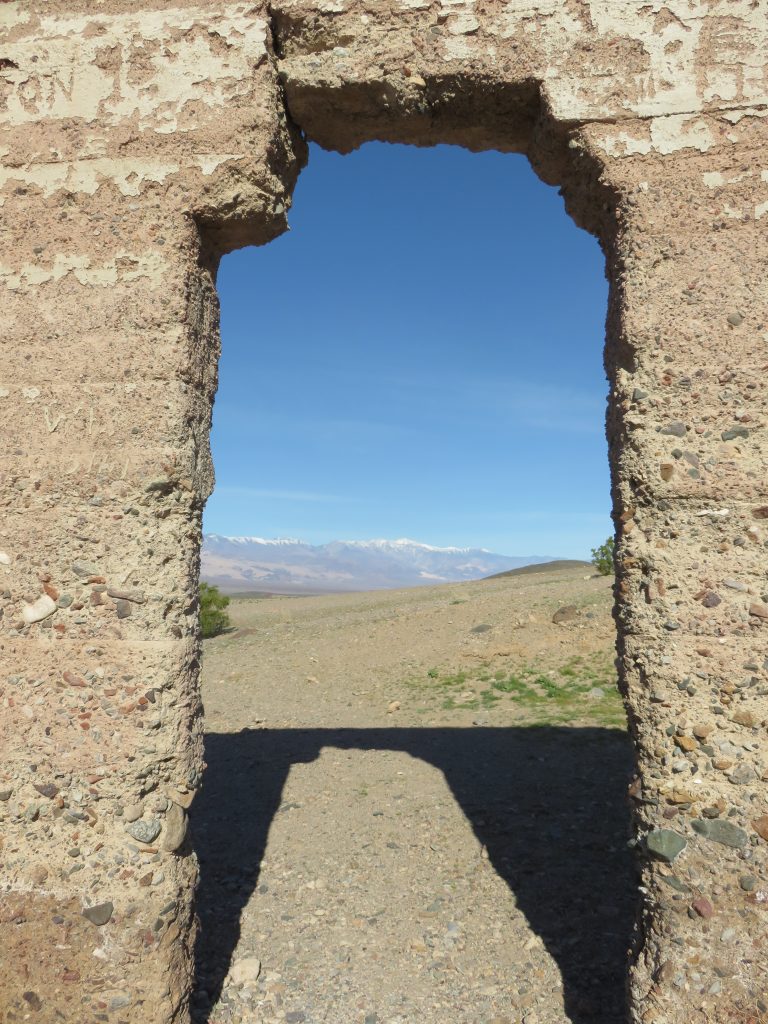
View of Panamint Mountains to the west from the ruins of the Ashford Mill site, Death Valley
The year was 1907 and many still suffered from the gold fever that started almost six decades earlier. Harold Ashford came to Death Valley in search of this treasure called gold. While death Valley is known for the Twenty Mule Team branded borax mining, many other minerals were mined, including gold.
Ashford discovered that the Keys Gold Mining Company had failed to do the proper assessment work on some of its claims and he took them over. The Keys Company tried to sue Ashford to get them back but lost in court. Ashford built the mill site on the floor of the valley, five miles from and 3,500 feet below his gold mine in the Black Mountains to the east. The ore proved to be not as rich and the cost greater than the gold obtained. Ashford leased the mine over the years. At times the lease holders would fail to pay him. Ironic the lease thief became a victim of thieves himself.
Ashford and he and his two brothers would work the mine from time to time when not in court trying to get justice. The last reported mining took place in 1941, 76 years ago. All that remains of the mill site is the stone walls of an office and concrete footings of the mill. The mine, miles up a steep road, offers the adventurous good exploring. We only surveyed the mill site.
Death Valley has such a rich history and we enjoy exploring it. As we are here for the art show later in the week, we will enjoy the rich diversity of visitors from all over the United States and from all over the world.
Our hobby on the road: Stained Glass Art, Minerals, Crystals, Jewelry, Rockhounding